- 2026 Midterm Elections:States Turn Blue Across America
- DoorDash Buys Instacart for $17 Billion
- L.A. Coastal Cities High Tides and Flooding
- Fall Back One Hour Halloween Night
- Vote For Rhonda Haymon “Superior Court Judge” Seat 64
- Bryson Fire Near Mulholland Hwy in Malibu
- California State Propositions
- Paramount has Aquired Warner Bros. it’s Official
- Metrolink Fare Increase Starts Today
- LA Dodgers Vs. Atlanta Braves
2026 Midterm Elections:States Turn Blue Across America
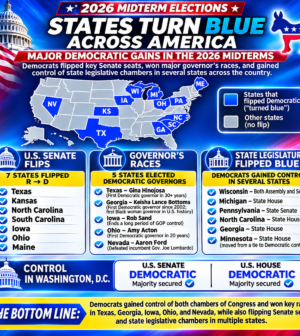
The November 3, 2026, midterm elections brought significant Democratic gains across the United States. Several states that previously had Republican governors, Republican U.S. senators, or Republican-controlled legislative chambers elected Democrats.
According to the Associated Press, Democrats have won control of both the U.S. House of Representatives and the U.S. Senate. They have also gained governorships and state legislative seats.
An important distinction: When a state turns blue, that does not necessarily mean the entire state is now controlled by Democrats. It may mean a Democratic candidate won the governorship, a U.S. Senate seat, or control of one or both chambers of the state legislature.
1. States that flipped U.S. Senate seats from Republican to Democratic
Seven states elected Democrats to U.S. Senate seats previously held by Republicans.
7 Democratic Senate flips
Texas
Kansas
North Carolina
South Carolina
Iowa
Ohio
Maine
Some especially notable developments include Kansas electing a Democratic U.S. senator for the first time since 1932, North Carolina electing its first Democratic senator since 2008, and Texas and South Carolina ending long Republican winning streaks for the seats involved.
2. Five states flipped their governor’s offices to Democrats
These five states elected Democratic governors to replace Republican leadership.
| State | Democratic winner | Significance |
|---|---|---|
| Texas | Gina Hinojosa | First Democratic governor elected in more than 30 years |
| Georgia | Keisha Lance Bottoms | First Democratic governor elected since 2002 |
| Iowa | Rob Sand | Ends a long period of Republican control of the governorship |
| Ohio | Amy Acton | First Democrat elected governor in 20 years |
| Nevada | Aaron Ford | Defeated incumbent Republican Gov. Joe Lombardo |
These results were reported by Stateline and the Wall Street Journal on November 4.
Two historic milestones emerged: Keisha Lance Bottoms became the first Black woman elected governor in American history, while Gina Hinojosa became Texas’s first Latina governor.
3. States where legislative chambers flipped blue
Democrats also gained control of several state legislative chambers, changing who can introduce, negotiate, and pass state laws.
| State | Legislative change |
|---|---|
| Wisconsin | Both Assembly and Senate flipped Democratic |
| Michigan | State House flipped Democratic |
| Pennsylvania | State Senate flipped Democratic |
| North Carolina | State House flipped Democratic |
| Georgia | State House flipped Democratic |
| Minnesota | State House moved from a tie to Democratic control |
Arizona and Texas also showed substantial Democratic legislative gains, although some chamber-control results were still developing in Wednesday’s reporting.
4. What the election means for Washington, D.C.
U.S. Senate
Democratic
Majority secured
U.S. House
Democratic
Majority secured
Party control reported November 4, 2026. Some individual election counts remain incomplete.
The change in congressional control means Democrats will be able to set legislative agendas, lead congressional committees, conduct oversight investigations, and exercise greater influence over federal legislation and Senate confirmations when the new Congress begins in January 2027.
President Donald Trump remains in office, so legislation will still involve negotiations between Congress and the White House.
5. Why did so many states vote Democratic?
Associated Press reporting and voter surveys identified several issues influencing the election:
-
Cost of living: Concerns about household expenses and inflation.
-
Economic uncertainty: Questions about wages, employment, and financial security.
-
Foreign policy: Voter concerns about the ongoing Iran war.
Government accountability: Demand for stronger congressional oversight and checks on presidential power.