- L.A. Coastal Cities High Tides and Flooding
- Fall Back One Hour Halloween Night
- Vote For Rhonda Haymon “Superior Court Judge” Seat 64
- Bryson Fire Near Mulholland Hwy in Malibu
- California State Propositions
- Paramount has Aquired Warner Bros. it’s Official
- Metrolink Fare Increase Starts Today
- LA Dodgers Vs. Atlanta Braves
- Jefferson Vs. Fremont High School
- Los Angeles Heat Wave Forecast
L.A. Coastal Cities High Tides and Flooding
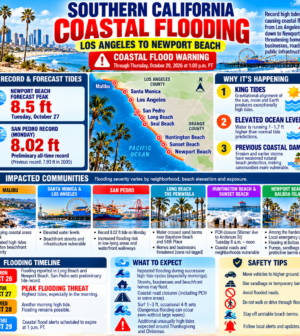
The major developing story is record-setting tides are already flooding Southern California communities, with Newport Beach under a local emergency declaration and coastal flood alerts continuing through Thursday. The longer-term concern is repeated flooding and worsening erosion as additional extreme tides approach later this year.
Tuesday, October 27, 2026 — Southern California’s coastline is experiencing exceptionally high ocean water levels, with repeated coastal flooding threatening beachfront homes, businesses, roads and public infrastructure from Los Angeles County south through Orange County.
The National Weather Service has issued coastal flood alerts lasting through Thursday, October 29, at 1:00 p.m. Pacific. Newport Beach, Long Beach, Huntington Beach and San Pedro are among the communities facing serious concerns.
The flooding is being driven primarily by unusually high king tides, combined with elevated ocean water levels and coastal areas already weakened by previous storms and erosion.
How serious is the flooding?
Newport Beach forecast peak today
8.5 ft
Tuesday, October 27
San Pedro record Monday
8.02 ft
Preliminary all-time record
Newport Beach recorded an 8.3-foot high tide Monday, flooding streets and businesses. An even higher 8.5-foot tide was forecast for Tuesday.
San Pedro’s tide gauge registered a preliminary 8.02 feet Monday, exceeding its previous record of 7.93 feet from January 10, 2005.
Water levels have been running approximately 1–1.7 feet higher than astronomical predictions in Orange County and 1–1.5 feet higher along Los Angeles County beaches.
Which coastal communities are threatened?

Long Beach and the Peninsula
Water has crossed sand berms near Bayshore Beach and 54th Place, threatening homes and businesses. Some homes had already been red-tagged after earlier coastal damage.

Record-setting water levels are increasing the risk of flooding in low-lying waterfront locations, harbor walkways and coastal infrastructure.
A precautionary Pacific Coast Highway closure between Warner Avenue and Anderson Street was announced for Tuesday from 8 a.m. to noon. Coastal roads and low-lying beach neighborhoods remain vulnerable.

Among the hardest-hit communities. Floodwaters reached streets and businesses near the Balboa Fun Zone. The city declared a local emergency, activated its Emergency Operations Center and deployed pumps, sandbags and protective berms.
Other vulnerable coastal locations include Malibu, Seal Beach and low-lying waterfront areas elsewhere along the Los Angeles and Orange County coastlines. The severity varies considerably by neighborhood, beach elevation and exposure.
Coastal flooding timeline: October 26–29
| Date | Expected conditions |
|---|---|
| Monday, Oct. 26 | Flooding reported in Long Beach and Newport Beach; San Pedro sets preliminary tide record |
| Tuesday, Oct. 27 | Peak flooding threat, with particularly high morning tides |
| Wednesday, Oct. 28 | Another morning high tide; flooding remains possible |
| Thursday, Oct. 29 | Coastal flood alerts scheduled to expire at 1 p.m. |
The NWS forecasts surf around 1–3 feet, with occasional 4-foot sets, for Orange County on Tuesday. This illustrates an important distinction: dangerous coastal flooding can happen even without enormous breaking waves, because the ocean’s overall water level is already unusually high.
Why is this happening, and will flooding continue?
Three factors are contributing to the problem.
-
King tides: The gravitational alignment of the sun, moon and Earth produces exceptionally high astronomical tides.
-
Elevated ocean levels: Water is running well above normal tide predictions, increasing the potential for seawater to overtop seawalls and enter streets.
-
Previous coastal damage: Repeated flooding and erosion have reduced natural beach protection, leaving some communities more vulnerable.
This is not necessarily continuous flooding every hour. Rather, vulnerable neighborhoods may experience repeated flooding during successive high-tide cycles, particularly in the morning.
Officials are also anticipating additional unusually high tides around Thanksgiving and Christmas, meaning coastal communities could face recurring flooding concerns into the winter.
What are cities doing to protect residents?
Newport Beach has activated its emergency response operations, reinforced beach sand berms, deployed pumps and sandbags, and prepared a sand replenishment project involving approximately 100,000 cubic yards of sand between 36th and 62nd Streets.
Residents in flood-prone areas should move vehicles to higher ground, use sandbags or temporary barriers, avoid flooded roads and stay off unstable beach berms. Do not walk or drive through floodwater.
Official information and updates