- California State Propositions
- Paramount has Aquired Warner Bros. it’s Official
- Metrolink Fare Increase Starts Today
- LA Dodgers Vs. Atlanta Braves
- Jefferson Vs. Fremont High School
- Los Angeles Heat Wave Forecast
- SoCal Coastal Weather Alert
- First Day of Fall September 22, 2026
- The 78th Emmy Awards 2026
- Catalina Island off the Coast of California set to eliminate Deer
California State Propositions
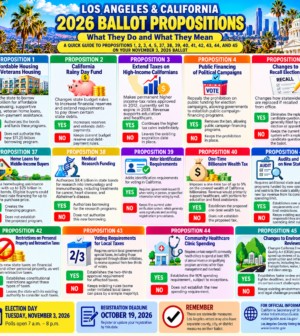
California voters will decide on 14 statewide propositions in the Tuesday, November 3, 2026, General Election.
These propositions cover major issues affecting California residents, including affordable housing, taxes, public education, healthcare, voter identification, government spending, and environmental protections.
All 14 propositions you listed are statewide measures, meaning voters throughout Los Angeles County and California will have the opportunity to vote on them. Los Angeles voters may also have separate county, city, or district measures.
Below is a plain-language explanation of each proposition, including what it would change and what voting YES or NO means. The information is based on the California Secretary of State’s official voter guide and the Legislative Analyst’s Office.
Propositions 1–5
Proposition 1 — Affordable Housing and Veterans Housing
What it proposes: Authorizes California to borrow $11.25 billion through state bonds to fund affordable rental housing, supportive housing, veteran home loans, and down-payment assistance.
-
YES: Allows California to issue the bonds and fund these housing programs.
-
NO: Does not authorize this new $11.25 billion borrowing program.
What it means for Los Angeles: Funding could support affordable housing construction, preserve existing affordable homes, and help eligible first-time buyers and veterans. The state would incur an estimated $500 million–$600 million annually in repayment costs for about 25 years.
Proposition 2 — California Rainy Day Fund
What it proposes: Changes state budget rules to increase financial reserves and extend requirements to pay down certain state debts.
-
YES: Changes the rules so California builds larger reserves and makes additional debt payments for longer.
-
NO: Keeps the current budget reserve and debt-payment rules.
What it means: Affects how much money California sets aside for economic downturns rather than immediately spending it on current programs.
Proposition 3 — Extend Taxes on High-Income Californians
What it proposes: Makes permanent the higher income-tax rates approved by voters in 2012, which are currently scheduled to expire in 2031. The revenue supports education and healthcare.
-
YES: Continues those higher tax rates indefinitely.
-
NO: Leaves the existing expiration date in place.
What it means: Maintains an existing source of funding for public schools and healthcare rather than allowing the temporary tax provisions to expire as scheduled.
Proposition 4 — Public Financing of Political Campaigns
What it proposes: Repeals California’s prohibition on public funding for election campaigns, allowing governments to establish public campaign-financing programs.
-
YES: Removes the statewide prohibition, allowing public campaign-financing programs under applicable laws.
-
NO: Keeps the prohibition in place.
What it means: Could change how some candidates finance campaigns, potentially allowing qualified candidates to receive public funds instead of relying entirely on private contributions. It does not automatically fund every candidate.
Proposition 5 — Changes to Recall Elections
What it proposes: Changes how California replaces statewide elected officials removed through a recall election.
-
YES: Eliminates the replacement-candidate question from the recall ballot. Vacancies generally would be filled through a special election or appointment, depending on the office.
-
NO: Keeps the current recall system, in which voters also choose a potential replacement candidate.
What it means: Would change how California selects a successor when voters recall a governor or another statewide official.
Propositions 37–39
Proposition 37 — Home Loans for Middle-Income Buyers
What it proposes: Creates a homebuying assistance program supported by up to $25 billion in revenue bonds. Eligible purchasers of qualifying newly built homes could receive fixed-rate financing covering up to 17% of the purchase price.
-
YES: Creates the financing program.
-
NO: Does not establish the proposed program.
What it means for Los Angeles: Could provide an additional financing option for eligible middle-income homebuyers, subject to income limits, minimum down payments, residency requirements, and home-price caps. The bonds would be repaid through homeowners’ loan payments.
Proposition 38 — Medical Research Funding
What it proposes: Authorizes $8.4 billion in state bonds for research into immunology and immunotherapy, including treatments for cancer, heart disease, and Alzheimer’s disease.
-
YES: Authorizes borrowing for the proposed research programs.
-
NO: Does not authorize this new borrowing.
What it means: California universities and qualifying research institutions could receive additional funding. The estimated state bond repayment cost is approximately $500 million annually for 25 years, with uncertain potential revenue from future discoveries.
Proposition 39 — Voter Identification Requirements
What it proposes: Adds identification requirements for voting in California.
-
YES: Requires government-issued identification when voting in person, or specified identifying information when voting by mail.
-
NO: Keeps the current voter identity verification system, which generally uses voter signatures and existing registration procedures.
What it means for Los Angeles: Voters would face additional identification requirements at vote centers or when submitting mail ballots. The state would also need to provide voter identification cards upon request. Implementation would involve additional election administration costs.
Propositions 40–45
Proposition 40 — One-Time Billionaire Wealth Tax
What it proposes: Imposes a one-time tax of up to 5% on the covered wealth of California billionaires, including investments, business ownership, securities, and certain other assets.
-
YES: Establishes the proposed one-time wealth tax.
-
NO: Does not establish the proposed tax.
What it means: Revenue would primarily support healthcare programs, with smaller portions for education and food assistance. Supporters argue the money is needed for public services; opponents raise concerns about taxpayers leaving California and economic consequences.
Proposition 41 — Audits and Limits on New State Taxes
What it proposes: Requires additional state audits of programs funded by new special taxes and restricts the state’s ability to exclude new tax revenue from its constitutional spending limit.
-
YES: Establishes the new auditing requirements and spending-limit restrictions.
-
NO: Keeps the existing auditing responsibilities and spending-limit rules.
What it means: Could affect the state’s ability to collect and spend revenue from new taxes, including the billionaire wealth tax proposed in Proposition 40.
Proposition 42 — Restrictions on Personal Property and Retroactive Taxes
What it proposes: Prohibits new state taxes on ownership of financial assets and other personal property, as well as certain retroactive taxes.
-
YES: Establishes constitutional restrictions against these types of taxes.
-
NO: Leaves the state with its existing authority to consider such taxes.
What it means: Could prevent California from implementing future wealth taxes on stocks, investments, and business interests. It also directly conflicts with elements of Proposition 40.
Important connection: Propositions 40, 41, and 42 overlap. If competing measures pass, their conflict provisions and the number of votes each receives could determine which provisions take effect.
Proposition 43 — Voting Requirements for Local Taxes
What it proposes: Requires certain local government special taxes, including those proposed through citizen initiatives, to receive approval from two-thirds of voters.
-
YES: Establishes the two-thirds approval requirement for the affected taxes.
-
NO: Keeps existing rules under which some voter-initiated local taxes can pass by a simple majority.
What it means for Los Angeles: Could change how voters approve taxes intended to fund local services such as public safety, transportation, housing, and other designated programs.
Proposition 44 — Community Healthcare Clinic Spending
What it proposes: Requires certain nonprofit community health clinics to spend at least 90% of annual revenue on qualifying program services rather than management and overhead.
-
YES: Establishes the 90% spending requirement, subject to specified exceptions.
-
NO: Does not establish the new spending requirement.
What it means for Los Angeles: Could affect how federally qualified health centers serving low-income and medically underserved communities allocate their budgets.
Proposition 45 — Changes to Environmental Reviews
What it proposes: Changes California Environmental Quality Act (CEQA) procedures to speed up reviews of qualifying construction and infrastructure projects, including housing, transportation, water, healthcare, and clean-energy projects.
-
YES: Establishes faster review procedures, tighter deadlines, and restrictions on certain court challenges.
-
NO: Keeps existing environmental review and legal challenge procedures.
What it means for Los Angeles: Could affect the approval process for apartment buildings, transit improvements, water infrastructure, and other development projects. Supporters emphasize faster construction; critics raise concerns about reduced environmental scrutiny and legal protections.
California propositions at a glance
| Proposition | Main issue | What a YES vote would do |
|---|---|---|
| 1 | Affordable housing | Authorize $11.25 billion in housing bonds |
| 2 | State budget | Increase rainy-day reserves |
| 3 | Schools and healthcare | Make high-income tax rates permanent |
| 4 | Elections | Allow public campaign-financing programs |
| 5 | Recall elections | Change how recalled officials are replaced |
| 37 | Homeownership | Create middle-income home loan assistance |
| 38 | Medical research | Authorize $8.4 billion in research bonds |
| 39 | Voter identification | Require additional voter ID |
| 40 | Billionaire tax | Establish a one-time wealth tax |
| 41 | Tax oversight | Add tax audits and spending restrictions |
| 42 | Tax restrictions | Prohibit specified new property and retroactive taxes |
| 43 | Local taxes | Require two-thirds approval for certain taxes |
| 44 | Healthcare clinics | Require 90% spending on program services |
| 45 | Environmental reviews | Speed up reviews of qualifying projects |
Source: California Secretary of State and Legislative Analyst’s Office.
Important voting dates
ELECTION DAY
Tuesday, November 3, 2026
October 19
Regular registration deadline
November 3
Polls open 7 a.m.–8 p.m.
For the complete official explanations, fiscal impacts, and arguments for and against each proposition, see the California Official Voter Information Guide.
For Los Angeles County-specific measures and your individual ballot, visit Los Angeles County Registrar-Recorder/County Clerk.
The key distinction is that these 14 propositions affect California statewide, while additional Los Angeles County and city measures depend on where you are registered to vote.