- Paramount has Aquired Warner Bros. it’s Official
- Metrolink Fare Increase Starts Today
- LA Dodgers Vs. Atlanta Braves
- Jefferson Vs. Fremont High School
- Los Angeles Heat Wave Forecast
- SoCal Coastal Weather Alert
- First Day of Fall September 22, 2026
- The 78th Emmy Awards 2026
- Catalina Island off the Coast of California set to eliminate Deer
- Lakers Honor Phil Jackson with a Statue at Crypto Arena
The House Votes On Permanent Daylight Saving Time
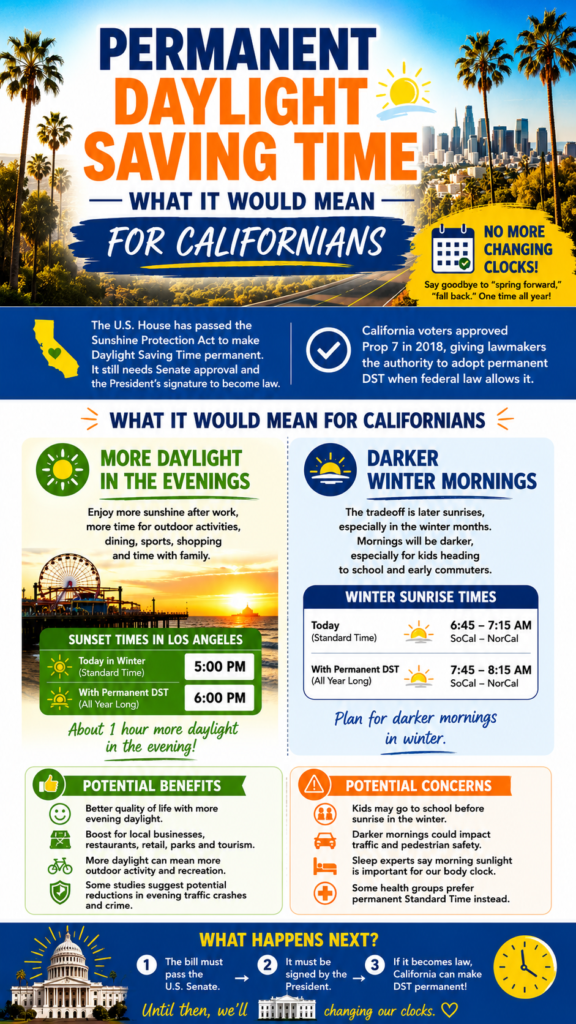
The U.S. House of Representatives has passed legislation that would make Daylight Saving Time (DST) permanent, eliminating the twice-a-year clock changes. However, the proposal is not yet law. It must still pass the U.S. Senate and be signed by the President before it can take effect.
What did the House approve?
The House approved the Sunshine Protection Act by a 308-117 bipartisan vote. The bill would:
- End the twice-yearly “spring forward” and “fall back” clock changes.
- Keep the nation on Daylight Saving Time year-round (the summer clock).
- Allow states that currently observe DST to stay on it permanently if the law takes effect.
What would it mean for California?
For Californians, if the bill becomes law:
No more changing clocks
- California would no longer switch between Pacific Standard Time (PST) and Pacific Daylight Time (PDT).
- The state would remain on Pacific Daylight Time (UTC-7) throughout the year.
More daylight after work
- Winter sunsets in Los Angeles would occur about an hour later than they do today.
- Many people would enjoy more daylight for outdoor activities, shopping, sports, and commuting after work.
Darker winter mornings
- The tradeoff is much later sunrises.
- In Southern California, winter sunrise would generally occur around 7:45–8:00 a.m.
- In Northern California, sunrise could approach or exceed 8:00 a.m. on some winter mornings.
Potential benefits
Supporters say permanent DST could:
- Eliminate the sleep disruption caused by changing clocks twice each year.
- Provide more evening daylight for recreation and family activities.
- Increase business for restaurants, retailers, parks, and entertainment venues.
- Potentially reduce some evening traffic crashes and crime because more people would be active during daylight.
Concerns raised by opponents
Critics point to several possible downsides:
- Children may travel to school before sunrise during the winter.
- Darker mornings may increase traffic and pedestrian safety concerns.
- Sleep researchers note that morning sunlight is important for regulating the body’s internal clock, and some medical groups continue to favor permanent Standard Time instead.
Didn’t Californians already vote on this?
Yes.
In 2018, California voters approved Proposition 7, which gave the Legislature the authority to pursue permanent daylight saving time if federal law allows it.
Because current federal law generally does not allow states to adopt permanent DST on their own, California has been waiting for Congress to act. If the Sunshine Protection Act becomes law, California would be able to move forward under the authority voters already approved.
What happens next?
The bill must still:
- Pass the U.S. Senate.
- Be signed by the President.
Until that happens, Californians will continue changing their clocks each spring and fall under current law.
If the legislation ultimately takes effect, it would mark the first permanent nationwide change to daylight saving time policy in decades.