- California State Propositions
- Paramount has Aquired Warner Bros. it’s Official
- Metrolink Fare Increase Starts Today
- LA Dodgers Vs. Atlanta Braves
- Jefferson Vs. Fremont High School
- Los Angeles Heat Wave Forecast
- SoCal Coastal Weather Alert
- First Day of Fall September 22, 2026
- The 78th Emmy Awards 2026
- Catalina Island off the Coast of California set to eliminate Deer
New E-Bike Laws in California
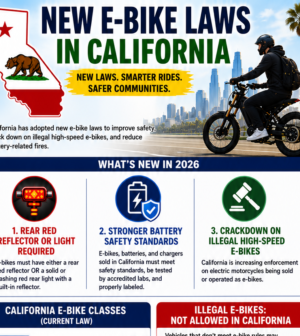
California and Washington are moving in the same direction. California has adopted several new e-bike laws and safety rules that riders should know about in 2026. The goal is to improve safety, crack down on illegal high-speed “e-motos” being sold as e-bikes, and reduce battery-related fires.
Washington’s new law, which takes effect June 11, 2026, is primarily designed to close loopholes that allowed high-powered electric motorcycles (“e-motos”) to be marketed and ridden as e-bikes. Under the new Washington rules, a legal e-bike must have fully functional pedals, a motor of 750 watts or less, and cannot exceed 20 mph under motor power alone. Vehicles that don’t meet those standards can be classified as motorcycles or mopeds instead.
What Changed in California 2026?
1. Rear Red Reflector or Light Required
As of January 1, 2026, e-bikes must have either:
- A rear red reflector, or
- A solid or flashing red rear light with a built-in reflector
This visibility requirement now applies more broadly and is intended to make riders easier for drivers to see.
2. Stricter Battery Safety Standards
New California rules require e-bikes, batteries, and charging systems sold in the state to meet recognized safety standards and be tested by accredited laboratories. Products must be properly labeled to show compliance. This was enacted in response to fires linked to unsafe lithium-ion batteries.
3. Crackdown on Illegal High-Speed E-Bikes
California is increasing enforcement against vehicles marketed as e-bikes that are actually electric motorcycles.
A legal California e-bike generally must:
- Have operable pedals
- Use a motor of 750 watts or less
- Fit within Class 1, 2, or 3 definitions
Vehicles exceeding those limits may be treated as mopeds or motorcycles, which can require registration, licensing, and other requirements.
Current California E-Bike Classes
| Class | Description | Top Assisted Speed |
|---|---|---|
| Class 1 | Pedal assist only | 20 mph |
| Class 2 | Throttle allowed | 20 mph |
| Class 3 | Pedal assist only | 28 mph |
Class 3 riders must be at least 16 years old and wear a helmet.
New Enforcement Authority
A new law gives law enforcement authority to impound certain illegal e-bikes and electric mobility devices that do not comply with California regulations.
Possible Future Changes
Several bills are being debated in Sacramento that could:
- Further tighten e-bike definitions
- Increase labeling requirements
- Prevent powerful electric motorcycles from being sold as e-bikes
- Create additional operating restrictions for minors on certain trails and bike paths
What Has NOT Changed
For legal Class 1, 2, and 3 e-bikes:
- No DMV registration is currently required.
- No driver’s license is required.
- No vehicle insurance is required.
- E-bikes remain generally treated like bicycles under California law.
Southern California Riders Should Pay Attention
Cities and counties across Southern California—including parts of Orange County, San Diego County, and Marin County—have been adopting additional local e-bike rules, age restrictions, and enforcement programs. Always check local ordinances where you ride.
California vs. Washington
| Rule | California | Washington (June 11, 2026) |
|---|---|---|
| Maximum motor power | 750 watts | 750 watts |
| Functional pedals required | Yes | Yes |
| Class 1 e-bike | 20 mph pedal assist | 20 mph pedal assist |
| Class 2 e-bike | 20 mph throttle | 20 mph throttle |
| Class 3 e-bike | 28 mph pedal assist | 28 mph pedal assist |
| Crackdown on e-motos sold as e-bikes | Yes | Yes |
| Motorcycle-style requirements for non-compliant vehicles | Yes | Yes |
California still recognizes Class 3 e-bikes that can provide pedal-assist up to 28 mph. Washington also continues to recognize the three-class system, including Class 3 e-bikes. The “20 mph” limit applies to throttle-only or motor-only operation, not necessarily to pedal-assisted Class 3 bikes.
About the “25 mph” Number
There is no current California statewide law that limits all e-bikes to 25 mph. California’s legal Class 3 e-bikes can still assist riders up to 28 mph. Washington’s new law focuses on preventing electric motorcycles from masquerading as e-bikes rather than lowering legal Class 3 speeds to 25 mph.
What This Means for Southern California Riders
Many of the bikes causing concern in Los Angeles, Orange County, and elsewhere—such as modified Sur-Rons, Talarias, and similar e-motos—can exceed 40-60 mph. California lawmakers are increasingly targeting those vehicles, not traditional Class 1, 2, and 3 e-bikes. If a vehicle exceeds the e-bike limits, it may need registration, licensing, and other motorcycle requirements.
So the short answer is: California is not adopting a 25 mph cap on all e-bikes. Instead, like Washington, California is trying to draw a clearer legal line between true e-bikes (up to 20 mph throttle or 28 mph pedal assist) and higher-powered e-motorcycles.