- California State Propositions
- Paramount has Aquired Warner Bros. it’s Official
- Metrolink Fare Increase Starts Today
- LA Dodgers Vs. Atlanta Braves
- Jefferson Vs. Fremont High School
- Los Angeles Heat Wave Forecast
- SoCal Coastal Weather Alert
- First Day of Fall September 22, 2026
- The 78th Emmy Awards 2026
- Catalina Island off the Coast of California set to eliminate Deer
La Brea Tar Pits Closing
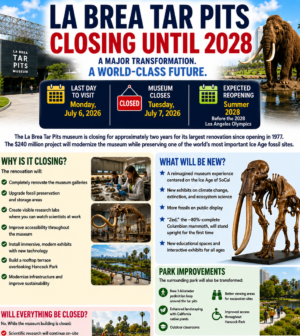
The La Brea Tar Pits contain the largest and most diverse collection of Ice Age fossils on Earth, with more than 3.5 million fossil specimens recovered from the site.
The renovation is intended to transform the museum into the new Samuel Oschin Global Center for Ice Age Research, making both its scientific work and public exhibits more accessible and engaging.
If you’re planning to visit, July 6, 2026, is your last opportunity before the museum closes for approximately two years.
The reopening is planned for summer 2028, in time to welcome visitors during the 2028 Los Angeles Olympic Games.
The La Brea Tar Pits museum is closing for approximately two years, from July 7, 2026, until summer 2028, to undergo its largest renovation since the museum opened in 1977.
The project is designed to modernize the museum while preserving one of the world’s most important Ice Age fossil sites.
Key dates
- Last day to visit: Monday, July 6, 2026
- Museum closes: Tuesday, July 7, 2026
- Expected reopening: Summer 2028, before the 2028 Summer Olympics in Los Angeles.
Why is it closing?
The closure allows construction crews to complete a major $240 million transformation that will:
- Completely renovate the museum galleries.
- Upgrade preservation and storage areas for millions of fossils.
- Create visible research laboratories where visitors can watch scientists at work.
- Improve accessibility throughout the museum.
- Install more immersive exhibits using modern technology.
- Build a rooftop terrace overlooking Hancock Park.
- Modernize the building’s infrastructure and improve sustainability.
What will be new when it reopens?
Visitors can expect:
- A reimagined museum experience centered on the Ice Age of Southern California.
- New displays highlighting climate change, extinction, and ecosystem science.
- Expanded fossil collections on public display.
- A reconstructed “Zed,” an approximately 80%-complete Columbian mammoth discovered at the site, standing upright for the first time.
- New educational spaces and interactive exhibits for children and families.
Changes outside the museum
The renovation also includes improvements to the surrounding park:
- A new 1-kilometer pedestrian loop around the tar pits.
- Enhanced landscaping with California native plants.
- Outdoor classrooms.
- Better viewing areas for excavation sites.
- Improved access throughout Hancock Park.
Will everything be closed?
No.
Although the museum building will close:
- Scientific research will continue on-site.
- Paleontologists will continue excavating fossils.
- Laboratory work and fossil conservation will continue.
- The tar pits themselves and portions of Hancock Park are expected to remain active research areas, though public access may vary depending on construction phases.
Special farewell events
Before closing, the museum is hosting several final events, including:
- Daily admission through July 6
- Final screenings of Titans of the Ice Age 3D
- A 1970s-themed disco farewell party celebrating the museum before construction begins.