- LA Rescinds 12 Anti-Camping Zones in Hollywood
- 405 Delays Sepulveda Pass Ventura Boulevard and Mulholland Drive 8/21-8/24
- Breaking News L.A. Lakers Sold for 12.5 Billion
- California Targets Ticket Resale Scams
- L.A. School District Back to School August 12, 2026
- President Trump Visits LA Today For Fundraiser
- Mayor Bass Rejects Lineage Cold Food Storage Rebuild Permit Request
- Hazardous Ocean Water, High Surf & Rip Currents
- Gardena 23rd Annual Jazz Festival
- Dangerous Surf & Rip Currents at LA Beaches
LA Rescinds 12 Anti-Camping Zones in Hollywood
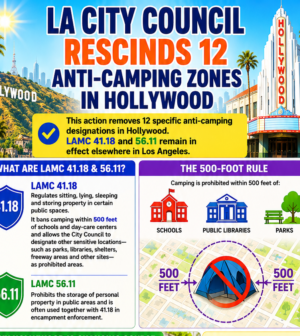
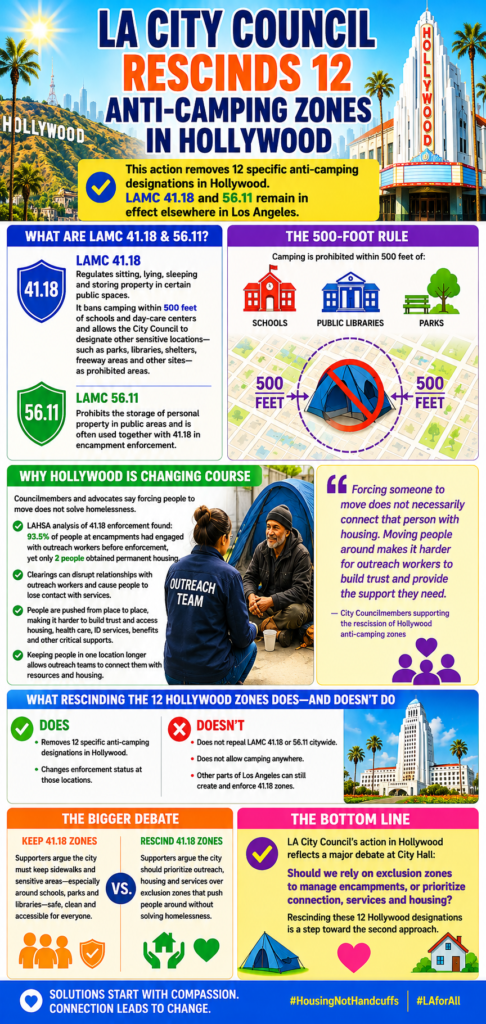
The Los Angeles City Council has moved to rescind 12 previously designated anti-camping zones in Hollywood, a significant local change in how the city applies its homelessness ordinances. The action does not repeal LAMC 41.18 or 56.11 citywide; rather, it removes specific Hollywood locations from special enforcement/designation.
What LAMC 41.18 and 56.11 do
Los Angeles Municipal Code 41.18 regulates sitting, lying, sleeping and storing property in certain public spaces. The law includes restrictions around schools and day-care centers and allows the City Council to designate additional sensitive locations—such as particular parks, libraries, shelters, freeway areas and other sites—as prohibited areas. The school/day-care restriction generally extends 500 feet.
LAMC 56.11 deals primarily with the storage of personal property in public areas and is closely connected with 41.18 enforcement. In practice, the two ordinances can be used together during encampment enforcement and cleanups.
Why Hollywood’s approach is changing
Hollywood is largely represented by Council District 13 and Councilmember Hugo Soto-Martínez, who has consistently opposed expanding 41.18 zones. His position is similar to that of Councilmembers Nithya Raman, Eunisses Hernandez and Ysabel Jurado, who have frequently voted against creating additional 41.18 zones. Recent council voting records show that divide clearly: Soto-Martínez, Raman, Hernandez and Jurado voted against new 41.18 designations in several 2026 cases.
The central argument for removing the Hollywood designations is: forcing someone to move does not necessarily connect that person with housing.
A LAHSA analysis of 41.18 enforcement found that clearing encampments could disrupt relationships between homeless residents and outreach workers, cause people to lose contact with services and reduce trust. The analysis found that 93.5% of people at the studied encampments had engaged with outreach workers before 41.18 enforcement, yet only two people ultimately obtained permanent housing during the period studied. Human Rights Watch cited those findings in its examination of Los Angeles’ enforcement system.
In other words, opponents argue that repeatedly telling people:
“You can’t stay here—move somewhere else”
This can result in people simply relocating several blocks away. Outreach workers then may have to locate them again, restart contact and rebuild trust before working on identification, benefits, medical or mental-health services, interim housing and ultimately permanent housing.
That concern isn’t new. Councilmember Raman has similarly argued that 41.18 can simply push unhoused residents from one location to another rather than resolve homelessness.