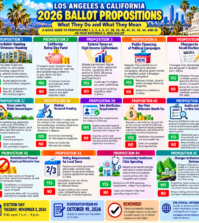
- California State Propositions
- Paramount has Aquired Warner Bros. it’s Official
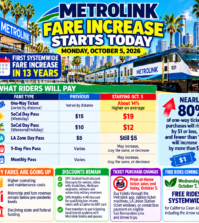
- Metrolink Fare Increase Starts Today
- LA Dodgers Vs. Atlanta Braves
- Jefferson Vs. Fremont High School
- Los Angeles Heat Wave Forecast
- SoCal Coastal Weather Alert
- First Day of Fall September 22, 2026
- The 78th Emmy Awards 2026
- Catalina Island off the Coast of California set to eliminate Deer
California’s Governor Race Debate
The 2026 California gubernatorial election is shaping up to be one of the most competitive and closely watched statewide contests in recent memory. With Governor Gavin Newsom barred from seeking another term due to California’s term limits, the race to succeed him has become remarkably open and crowded, drawing a diverse field of candidates from both major parties as well as independents and minor party contenders. The primary election is scheduled for June 2, 2026, under California’s unique top-two nonpartisan primary system — meaning all candidates appear on the same ballot and the two with the highest vote totals, regardless of party, will advance to the general election on November 3, 2026.
From the outset, the field has been marked by uncertainty and fragmentation. Early polling and media coverage indicate that a substantial share of likely voters remain undecided, with no single candidate commanding a solid lead. In one Emerson College poll, Republican candidates Chad Bianco and Steve Hilton, as well as Democrats Eric Swalwell and Katie Porter, were all clustered near the top of the pack, while nearly a third of respondents were undecided. This lack of a clear frontrunner in a state that has been reliably Democratic in statewide elections has fueled speculation about whether an unusual outcome — such as two Republicans advancing to November — might occur due to vote-splitting among Democrats.
Among Democratic contenders, several high-profile figures have declared their campaigns. These include former U.S. Representative Katie Porter, known for her aggressive oversight of corporate executives during her time in Congress; former U.S. Health and Human Services Secretary Xavier Becerra; U.S. Representative Eric Swalwell; former Los Angeles Mayor Antonio Villaraigosa; former state controller Betty Yee; and Tony Thurmond, the current state superintendent of public instruction. Billionaire activist Tom Steyer has also entered the race, focusing his campaign on high living costs and climate issues.
On the Republican side, the field features Chad Bianco, the Riverside County Sheriff who quickly became the first major GOP candidate to formally enter the contest and has emphasized public safety, homelessness, and affordability concerns. Conservative commentator Steve Hilton likewise brings national visibility to the race, campaigning as an outsider with a focus on immigration and government reform. A handful of other Republican and independent candidates have also filed, though none yet has broken through in statewide polling.
A notable figure who will not be on the ballot is former Vice President Kamala Harris. After months of speculation — and even early polls placing her as a potential frontrunner — Harris announced she would not seek the governorship, leaving the field open to other Democratic leaders.
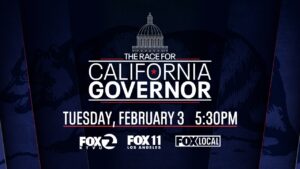
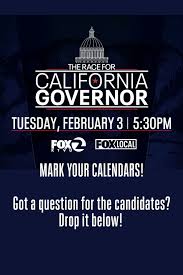
As candidates jockey for attention and support, campaign forums and televised debates have become pivotal moments for differentiating platforms and appealing to voters. One of the earliest and most significant of these is scheduled for Tuesday, February 3, 2026, when a major gubernatorial debate will be broadcast live from the Ruth Williams Bay View Opera House in San Francisco. The event is set to take place from 5:30 p.m. to 8:00 p.m. Pacific Time and will air on both KTVU FOX 2 in the San Francisco Bay Area and KTTV FOX 11 in Los Angeles, as well as via the FOX LOCAL streaming app. Moderators from both stations will host the debate, which is expected to include some of the leading candidates such as Villaraigosa, Yee, Swalwell, Hilton, Steyer, and Thurmond. This debate provides an early look at how candidates articulate their policies on pressing statewide issues, from housing costs to public safety and immigration.
Indeed, key issues dominating the campaign discourse reflect the everyday concerns of Californians. Rising housing costs and affordability are at the forefront, with candidates proposing a range of solutions from increased housing production to regulatory reform. Homelessness and public safety remain central themes, with debates over funding, enforcement, and social services. Immigration policy — particularly enforcement and public benefits for undocumented residents — has also emerged as a flashpoint, especially among Republican contenders. Finally, broader debates over education, climate policy, and economic regulation highlight the ideological diversity within the field.
As the calendar advances toward the June 2 primary, voters will receive official voter guides and candidates’ statements, and the certified list of ballot participants will be finalized. The top two finishers from that primary — potentially from the same party due to the nonpartisan structure — will move on to face off in the November general election for California’s highest office. By then, the February debate and subsequent forums will have offered early signals about who is gaining momentum and how the electorate is responding to the crowded, unpredictable landscape of this historic race.